

Our third council meeting of 2026 was held on Tuesday, 10 February.
The full meeting agenda, reports and video recording are linked below, as well as the draft Minutes.
Halifax Regional Council – February 10, 2026
February 10, 2026 Regional Council Draft Minutes
This was a relatively short agenda but could be potentially very impactful to our regional center communities.
16.1 Mayor Fillmore
“Motion:
That Halifax Regional Council direct the Chief Administrative Officer (CAO) to prepare a staff report and return to Council in June 2026 with recommendations on how the municipality can implement and deliver a pilot project of High Occupancy Vehicle lanes in current bus only lanes to be prioritized based on impacts to transit, effectiveness, and feasibility on congested corridors in HRM.”
HOV lanes are something I had considered bringing to council myself back in July when the conversation about bike lanes causing traffic congestion was going on. Converting some general traffic lanes around HRM to HOV (usually two or more people in a vehicle) is something I would be interested in looking at closer. We have the legislative authority to do this, and it could be an incentive for people to carpool.
This motion, however, I am fundamentally opposed to, as we already have poor on time performance (67%) for our bus network. I would prefer to add more buses to our bus lanes, that can carry 60 people, over personal vehicles with two or more people inside. Increasing the frequency and reliability of public transit is key to attracting more ridership (which equals fewer personal vehicles on the road, so there is less traffic congestion when we need to drive). Adding more paths for vehicular traffic to flow, induces demand for more driving, which takes us in the opposite direction from our modal shift to other modes of transportation goals.
This motion does not ask for the pros and cons of adding HOVs to our bus lanes, it specifically directs staff for “recommendations on how the municipality can implement and deliver a pilot project”, so that may be what we will see come back to us, even if staff think it is a bad idea (they may issue a negative recommendation, but that is not common). This is exactly what happened with the Morris Street complete street design. Staff came back suggesting Clyde or South as an alternative, not because they think it is a better design, but because council asked for alternative routes.
Morris Street: Peninsula South Complete Streets Project East Connection
The motion passed at 12 – 3. I voted No. Public Works Minister Fred Tilly would like to see some bus lanes converted to HOV lanes in less than a year. I know that some of my colleagues think that this staff report will help us to get out in front of that directive with some evidence-based advice, but I am skeptical. I’m also concerned about our vision for BRT. We recently widened Bayers Road from 4 to 6 lanes so we could have dedicated bus lanes. What will happen to Robie Street if we widen it for bus lanes and are overruled by a future council or provincial government about who can drive in them?
18.1 – Mayor Fillmore – AAA Alternatives for 2028/29 & 2029/30 Bicycle Network Capital Projects
“Motion:
THAT Halifax Regional Council direct the Chief Administrative Officer (CAO) to provide a staff report that would:
• Identify cost saving opportunities by considering alternatives to the proposed all ages and abilities (AAA) bikeway network that do not meet the AAA standard for projects planned for construction in 2028/2029 and 2029/2030.
• Identify opportunities to prioritize network implementation that closes gaps in the network, rather than upgrading existing segments.”
I tried to defer this motion, as it was an added item, so the public was not aware that it was coming, and it is a change from our strategic direction on this topic since 2017 (usually items are public on Friday at noon before a council meeting). This was also not a time sensitive motion, which is more appropriate for an added item, though not necessary per our Administrative Order 1.
For example, I learned from one resident after the vote about this national naming convention, which may be more appropriate than the AAA name after 9 years has passed since the minimum grid was planned. The point being that safe infrastructure is required; no matter what label we give it:
The Canadian Bikeway Comfort and Safety (Can-BICS) Classification System
I lost the vote to defer, 7 – 8. I voted Yes.
I am very much open to looking at ways to improve our roads (beyond our minimum grid network) to be more cycle friendly without protected infrastructure such as removing parking (i.e. on Veteran’s Memorial which had parking spots added 2 or 3 years ago, making it harder to bike without getting doored or harassed) or adding painted bike boxes at the front of intersections (see Almon and Agricola, the east side) to give people on bikes a head start and be more visible to motorists. Even looking at specific difficult segments of our minimum grid to complete and making compromises would be something to ponder case by case, but the broad nature of this motion is something I cannot support.
This motion looks at fundamentally changing the purpose of our minimum grid network. The purpose is to offer a safe place to cycle, so that current riders are protected if they choose to use the network, and future riders are provided a comfortable place to consider changing their mode of transportation for certain trips. The low-cost option for “cycle infrastructure” is a painted line, like we have on Windsor and Bell currently. It is helpful that there are no cars parked on these roads, but there is no protection from passing vehicles when riding in this situation. Furthermore, the places that we could easily install a painted line bike lane, we could also easily add flex posts for very limited funds, and call it AAA, but these are generally locations like University Avenue, where there is no political will/stakeholder interest to remove parking.
So, it is not the cycling infrastructure that is expensive, it is the unwillingness to reallocate travel lanes or parking spaces to micromobility traffic (or delay motor vehicle traffic in the case of the Macdonald bridge) that is the challenge. Cities that have made great strides in improving cycling infrastructure in a short time frame have reallocated road space. Montreal converted many streets from two to one-way to make space for cycling. London (England) has had a congestion charge since 2003, and with fewer vehicles entering the city center, they are able to reallocate lanes to micromobility traffic.
I am not interested in spending taxpayer money on a cycling network that will not get used. If we are only looking at the cost, and forgoing comfort and directness and priority, we will not inspire more people to cycle and we will have gone through all of this work for very little progress.
Hopefully as these 2028 – 2030 projects come forward to council (as all segments do), we will be able to see the pros and cons of built in and tactical AAA designs, and the non-AAA alternative for consideration of all the tradeoffs and make smart choices before proceeding.
As far as the closing gaps vs upgrading segments, other roadwork projects come into play. For example, the sidewalks are crumbling on Lower Water Street, so they will be upgraded this spring. Minor improvements will be made to the micromobility lane as well, because it is cost effective to do so at the same time.
This motion passed 10 – 5. I voted No.
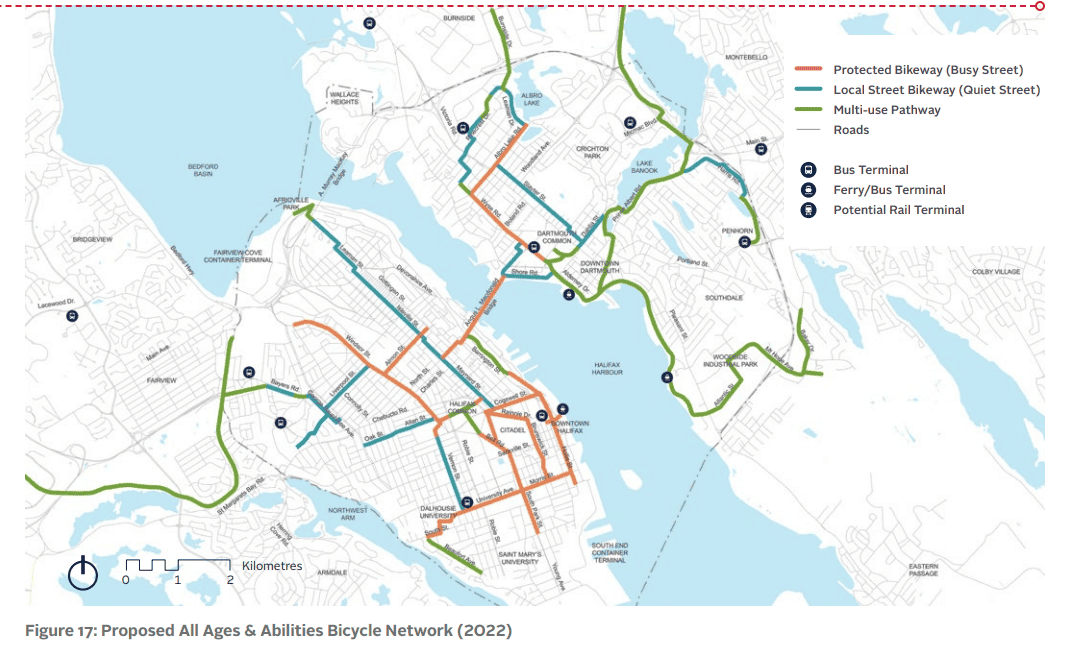
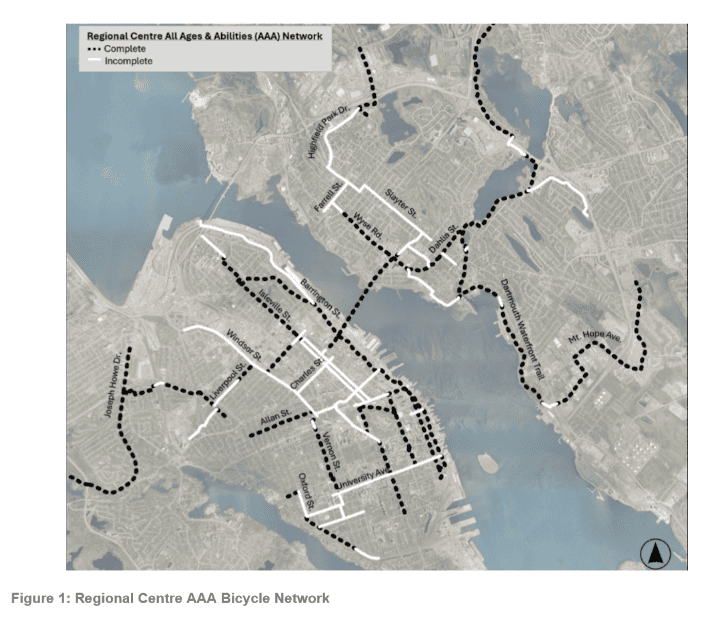
Here are the original minimum grid network (2017, IMP) and the current state of the network (2026 staff report). These maps are challenging to read, but you can see where the network routes have changed since 2017, and the progress in infrastructure installation. I’m not sure why or how those changes happened. The original plan for having the minimum grid installed was 2022. Keep in mind that a minimum grid is just that; upgrades to cycling infrastructure are iterative and open to continuous improvement, as is the rest of HRM infrastructure.
18.2 – Cathy Deagle Gammon – Facilities MDF Multi District Review
“Motion:
THAT Regional Council receive an in-person presentation /update on the MDF Multi District Facilities Review once the What we Learned Report has been completed.”
This motion was to bypass our CPED committee and bring this report straight to regional council as there are budget implications. Centenial Pool is a MDF.
This motion passed 13 – 1. I voted Yes.