
Council received a presentation, asked questions of clarification of staff and then debated a motion regarding the Nova Scotia Capped Assessment Program impacts at our 29 September 2026 Council meeting (Item 14.1).
This is the Information Report provided to council for our 25 August 2026 council meeting agenda, which Councillor Steele brought forward for a presentation and discussion on 29 September 2026:
Nova Scotia Capped Assessment Program Impacts – 12 August 2026 Report
I highly recommend that you read the report and/or watch the staff presentation and Q&A (click on Item 14.1 for the video). Staff did a fantastic job of bringing the facts to an emotionally charged topic. If the CAP were to be reformed, phased out or eliminated by the province, tax relief and deferral programs could be enhanced to help those who need it.
Halifax Regional Council – September 29, 2026
Here is the motion form that Councillor Steele prepared for our 29 September 2026 meeting, which outlines the reasons for bringing the motion and the outcome sought, in addition to the motion wording. I am very grateful for her work and persistence on this topic, as I am for the work of staff who wrote and presented the report findings.
Here is her motion text, with Mayor Fillmore’s friendly amendment implemented (removing the word Opposition). All party support will be required to make progress here in the legislature.
14.1 Councillor Steele – Nova Scotia Capped Assessment Program Impacts
1. Review the growing inequities identified in the HRM Capped Assessment Program Report and work with HRM and other Nova Scotia municipalities to identify practical solutions that improve fairness and support housing affordability.
2. Share the HRM Report with the Leaders of all Parties to support a broader provincial discussion about the impact of the Capped Assessment Program on housing affordability.”
This motion passed 12 – 5 after a lengthy discussion and debate. I voted Yes, because I would like to see tax fairness based on the ability one has to pay (whether you rent or own), rather than the tenure in one’s property.
(Tax fairness based on the costs of municipal services received is a related yet separate topic. HRM is working towards fairness and financial sustainability in this regard by our settlement patterns and development decisions and area rates applied. This is an area that council has more control over, yet the issue is also emotionally and politically charged.)
This post is an opportunity for me to share some of the report highlights with you, both in general, and specifically for D7, the only district to be singled out in the report. (I’ve compiled tidbits that stood out for me in the report in a different order.)
“EXECUTIVE SUMMARY
The Capped Assessment Program (CAP), introduced by the Province of Nova Scotia in 2005, was designed to protect residential property owners from sudden spikes in assessed values and related tax impacts. While the program provides stability for long‑term homeowners, it has created significant inequities, market distortions, and other, most likely unintended, consequences within the municipality. The CAP is provincial legislation and cannot be amended by HRM.”
“The Municipality’s overall revenue requirement does not change because some properties receive the CAP benefit. When one taxpayer pays less due to the cap, that revenue must be recovered from the rest of the tax base. As a result, taxpayers who are not eligible for the CAP pay a larger share of the total property tax burden.”
“The CAP reduces the taxable assessment base, requiring higher tax rates to meet the municipality’s revenue needs. In 2026/27, the total urban residential tax rate was $1.135 (including all area rates such as Local Transit, Right-of-Way, etc.) under the CAP system; using market values, the rate would have been $0.854; inclusive of all urban tax rates, area rates, and provincial mandatory rates.”
My house 2026/27 tax bill (home purchased in 2014):
6651 x 1.135 = $7 549
My bill if the CAP did not exist in 2026/27:
9947 x 0.854 = $8 495
My house if a new buyer paid the municipal tax bill 2026/27:
9947 x 1.135 = $11 290
“The Capped Assessment Program provides stability for long‑term homeowners but has created systemic inequities, market distortions, and fiscal challenges for HRM. The program disproportionately benefits higher‑value properties and long‑term owners while shifting the tax burden to new buyers, non‑owner‑occupied units, and nonprofit housing providers. Any meaningful reform would require provincial legislative change.”
Key Findings
1. CAP shifts the tax burden onto non‑capped properties:
In 2026, 79% of taxable properties (Residential, Commercial and Resource) were capped, meaning the remaining 21% shoulder a disproportionately higher share of municipal taxes.
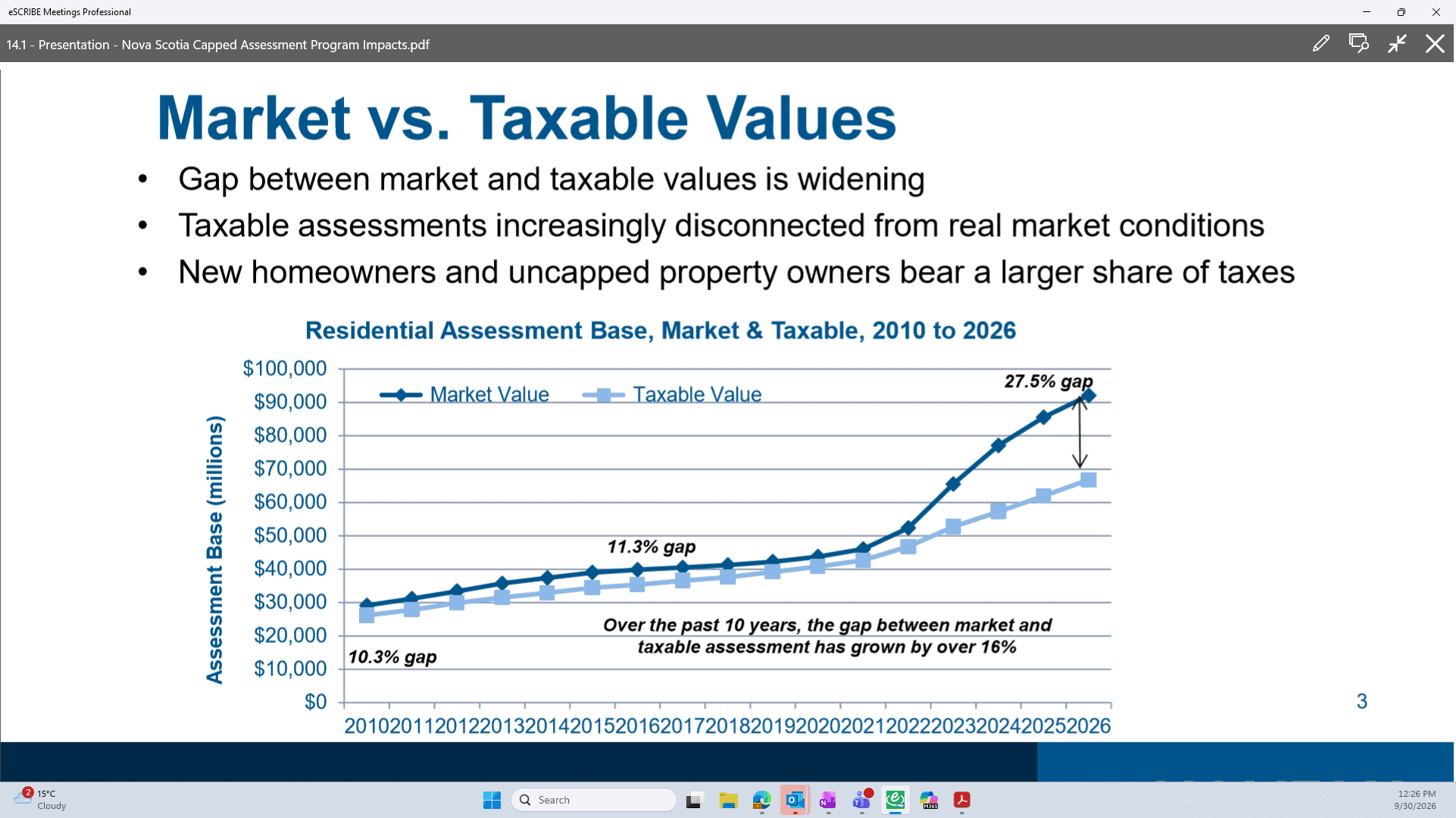
2. The gap between market and taxable values is widening:
disconnecting taxable assessments from real market conditions: increasing inequities between long‑term and newer homeowners.
3. CAP creates substantial inequities among homeowners
Tax bills vary widely among similar properties—even on the same street—based solely on how long owners have been in the CAP
4. New buyers face “tax shock”
When a property sells, the CAP resets to market value, potentially causing significant increases in the new owner’s first tax bill.
5. Rental market inequities are significant
In 2026, only 36 of 2,536 large rental properties (1.4%) qualified for the CAP, all co‑ops. There are 75 021 dwelling units in those properties. In HRM there are 126 463 Single-Family Households of which 89.2% are capped.
Without the CAP in 2026/27, uncapped apartment buildings would have paid an average of $16,296 less per property, or $519 per unit, with per‑unit savings remaining consistent across building sizes.
6. CAP benefits are unevenly distributed
Higher‑value properties receive the largest dollar‑value benefit due to the lower tax rate applied to capped assessments. Long‑term owners, particularly seniors, benefit from stability. Lower‑income homeowners benefit through continued eligibility for provincial programs tied to taxable assessment thresholds.
7. District‑level disparities are pronounced
District 7, Halifax South Downtown, has the lowest CAP eligibility (60% vs. 89% municipal average), largely due to non‑owner‑occupied condominiums. Among the properties that are not capped, 89 percent are condominiums, which must be owner‑occupied to qualify for the CAP.
This lower rate of CAP eligibility, combined with higher assessed values in the urban core, drives significantly higher taxable assessments. The average taxable value for single‑family homes in District 7 is 93 percent higher than the municipal average. Using the 2026/27 urban general tax rates and all associated urban rates, this results in District 7 homeowners paying, on average, approximately $3,760 more in property taxes per year.
8. Housing Market Impacts
The CAP discourages buying, selling, and renovating due to the loss of eligibility, reducing market mobility and potentially suppressing deed transfer revenue.
CAP Beneficiaries:
a) higher value property owners – The higher the market value, the greater the benefit of the CAP.
b) long term owners, particularly seniors. There are tens of thousands of single-family homeowners who are paying lower property taxes because of the CAP.
c) lower income homeowners who qualify for provincial programs tied to taxable assessment thresholds
e) residents of residential properties with fewer than four dwelling units (assuming the savings are passed on by the owner)
f) residents of manufactured home parks (assuming the savings are passed on by the owner)
g) cooperative housing residents
h) Multiple properties owned by the same Nova Scotia resident qualify if each meets the criteria below:
• At least 50% of the property is owned by a Nova Scotia resident.
• It is a residential property with fewer than four dwelling units. Residential properties include manufactured homes, manufactured home parks, cooperative housing, and the residential or resource portions of a commercial farm.
• If the property is a condominium, it must be owner-occupied.
• The property has been owned for at least one year, or ownership has remained within the family.
Property owners can have an infinite number of properties eligible for the CAP, if the criteria are met. For example, one Nova Scotia resident could own 30 single-family homes and receive the CAP on all the properties – residing in one property and renting out 29 properties at market values.
CAP Bearers:
a) Approximately 16,000 homeowners would actually pay less tax if the CAP were removed, due to the way tax rates would adjust under a market‑value system. Many property owners would save between $5,000 – $10,000 per year. The average market value of residential property owners who would save on their property tax bill is $598,100 while the average taxable value of these same properties is $520,800.
b) The CAP does not apply to commercially assessed properties.
c) residents of 4 or more dwelling unit rentals (assuming the taxes are built into the rent)
d) non-owner-occupied condos (assuming the taxes are built into the rent)
e) Residential or vacant resource property owners that experienced a non-familial ownership change in the previous year.
f) Newly constructed property owners (or renters assuming the taxes are built into the rent)
g) renters of properties owned by a nonprofit or charitable organization (assuming the taxes are built into the rent)
h) owners or renters of properties owned by a commercial enterprise (dwellings) (assuming the taxes are built into the rent)
i) owners of properties where at least 50% of the property is owned by an out of province resident